COL. STEVE WARREN: Welcome members of the fourth estate. It's great to see you here.
So they've been able to do that multiple times since this summer.
LT. GEN. ANDERSON: Okay. General -- the generals have all been engaged with their new leadership. President Ghani has been -- he's gone out and congratulated them. He's empowered them. He's gone to hospitals to go see the wounded. He's popped in police stations at 11 o'clock, midnight to see what folks are doing on duty. But he's been very grateful and thankful of the ANSF for all those things I described, what they've accomplished here this past year. And he's been very engaged, heavily engaged with the leadership of the police, of the army, in dialogue with corps commanders, provincial chiefs of police. He addressed each of the ministers' conferences a couple weeks ago and the combined conference between the police and the army. So there's been a lot more enhanced dialogue, a lot more communication, and a lot more support of their efforts to enhance security here in the country. COL. WARREN: Sir we will take one more question and then go to closing comments.
|
Wednesday, November 5, 2014
Department of Defense Briefing by Lt. Gen. Anderson in the Pentagon Briefing Room via satellite from Afghanistan

TANK TRENCH

Russia Pushing Limits of International Order,
Russia Pushing Limits of International Order, Dempsey Says
By Lisa Ferdinando
DoD News, Defense Media Activity
WASHINGTON, Nov. 5, 2014 - Russia is "pushing on the limits of international order," the chairman of the Joint Chiefs of Staff said today.
Russian President Vladimir Putin and Russia in general are pushing the limits because they don't believe the international order was crafted in a way that met their national interests, Army Gen. Martin E. Dempsey said during a question-and-answer session at an event on hiring veterans in New York.
Putin and Russia express a sense of victimization following the collapse of the Soviet Empire, the chairman said. Noting that the Russian president recently delivered a speech on that narrative, Dempsey characterized it as "an anti-Western soliloquy that literally lasted for about three hours."
NATO Commitment is Principal Responsibility
"Our principal responsibility here, of course, is our NATO commitment, notably the Article 5 responsibility, which says an attack on one is an attack on all," he said. "Twenty-eight nations of NATO are committed to living up to that."
Dempsey said the difficulty is in Georgia, Moldova, and Ukraine -- the nations located between NATO allies and Russian aggressiveness. To help in meeting that challenge, he said, the U.S. military needs to do different things with rotational presence.
"We probably need to do some things in every domain -- air, sea and ground," he said. "It's going to, I think, require us to put forces back into Europe that we had taken out."
The chairman said he doesn't expect the American forces in the region to be "dramatically big," but he added that "they'll be substantial enough to allow us to deter Russian aggression against our NATO allies."
Russia is creating an unstable situation, Dempsey said, and it has also "kind of lit a fire of nationalism."
"Once you light that fire, it's not controllable," the general said. "I am worried about Europe."
For about 20 years, Dempsey said, Europe has been complacent with its security. "I don't think they can afford to be complacent any longer," he added.
Other International Topics
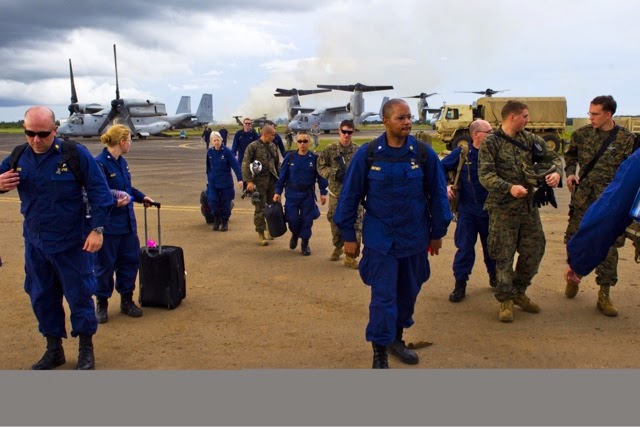
Questions for the chairman also touched on other international topics. U.S. service members fighting Ebola in Liberia are "making a real difference," he said in response to a question on that subject.
Separately, when asked about whether the United States should have kept residual forces in Iraq, Dempsey said he was in favor of such an arrangement.
He said the United States did not finish some things in Iraq, such as logistics and intelligence architecture for Iraqi forces and in providing them with close air support and lift capabilities. But the U.S. capability couldn't remain there without an agreement that protected U.S. forces, the chairman said.
"History will be the judge," Dempsey said. "To my satisfaction, we tried to get them to a place where they could provide us the protections and immunities we need." However, he said, he did not want to leave U.S. forces there with Iraq's "particular judicial system at the time without protections and immunities."
The general said he thinks that over the next several years there will be a requirement to help Iraq with an operations center "so that we can share intelligence better and we can watch how they are executing their campaign plan."
"I think we're going to have to rebuild pieces of the Iraqi army at secure bases," he added, "and we've got about three or four of them identified that we think we need to stand up."
Statement of California Democratic Party Chairman John Burton on 2014 Election Results
It appears Democrats across the nation will always have California. On a night that saw Republicans make gains across the nation, much like in 2010, California has held firm. At the statewide level, California remains a deep blue beacon because of the bold leadership of Jerry Brown and our strong Democratic majority in Sacramento.
In a repeat of 2010, California Democrats swept all statewide offices this year and even helped pass the most significant criminal justice reform measures in decades with Proposition 47.
Democrats under Governor Brown have accomplished much in just four short years and our victories at the statewide level serve as an affirmation of that reality.
While the results were less decidedly in our favor at the district level, the reality is California Democrats have had an embarrassment of riches for the past several election cycles and that has left us with many seats to defend, often in Republican leaning territory in low turn out cycles.
We look forward to recommitting to our efforts pressing into Republican strongholds, in particular the Central Valley. Many of the seats that were lost last night will be regained in just two years and there are many more which will be ripe for the picking from Republican hands in 2016.
Open Architecture Cuts Cost, Promotes Competition, Official Says
By Cheryl Pellerin
DoD News, Defense Media Activity
WASHINGTON, Nov. 5, 2014 - Adopting open architectures in systems that the Defense Department buys from industry can reduce costs and facilitate competition, the assistant secretary of defense for acquisition said here yesterday.
Katrina G. McFarland was the morning keynote speaker at Defense Daily's 2014 Open Architecture Summit, which focused on open architecture in military acquisition.
Open architecture is a system in which the specifications are made public to encourage third-party vendors to develop add-on products. In defense acquisition, the term extends to creating separate modules in a larger system, each of which can be updated to modernize the entire system without rebuilding it, and the modules can be produced by different vendors, promoting diversity and competition at the module or component level.
Acquisition Strategies Implement Open Systems Architecture
McFarland said 75 percent of Defense Department acquisition strategies implement open systems architecture across all services and agencies. "The importance that we place on it is not just in word only, it's in action," she added.
"This department is seriously engaged in trying to understand how to help our program managers and our department and our industry look at open architecture and its benefits," McFarland said, "and understand truly what our objectives are related to intellectual property and making sure that we're doing it based on the best interest of national security relative to a business case."
According to the August 2014 Guidelines for Creating and Maintaining a Competitive Environment for Supplies and Services in the Department of Defense, developing an open system may be less expensive than traditional systems because of reductions in material cost, the use of commercial standard interfaces, and the more effective maintenance and modification possible over a system's lifecycle.
Open systems architecture also may be used to overcome barriers to competition by applying open standards and open business model principles, the Guidelines book says.
McFarland told the audience that confusion exists in the defense industry about intellectual property and open systems architecture. "The government has no interest in pursuing intellectual property when it's the 'secret sauce' of a company," she said, "but ... we are very interested in what I could call the interfaces."
Owning Interfaces Allows Department to Compete
Owning the interfaces and the architecture allows the department to compete, the assistant secretary explained.
"Conceptually, you're trying to get your program managers ... to understand when they design their functional architecture that they have to take into account what they must go after in terms of ... modularity so they can build and change in that area," McFarland said. "You should have a logic behind what you're doing, and it should be based on a business case, and you should be able to articulate where you consider those threats to be most prevalent so you can [determine] how to address that interface."
In terms of defense exportability, she added, "I'm very interested in ensuring that when I build something I know will have export trade related to it."
"Because of our relationship with other nations," she added, "I want to make sure I've protected the ability of those countries to implement their aspects [of open architecture] as well."
Guidelines Offer Information on Acquisition Practices
McFarland said the Guidelines book offers good information about the use of open architecture in military acquisition practices.
"In that book you will find ... highlights of what we believe people need to think about, ... and we give examples throughout the document of how [open architecture] works to the benefit of industry, to the benefit of the government, and most importantly, to the benefit of national security," she said.
The book advises that "the essence of OSA is to take the long-standing engineering practice of modularization and adding to that the rigor of ensuring those modules can be separated from each other in a well-orchestrated manner."
These technical practices, the book adds, "provide the power to acquire components of a system from separate sources and yield a business model that facilitates competition. OSA enables increased opportunities for competition of systems upgrades and competition at the subsystem level to improve innovation."
Even fielded systems can create a competitive environment or open-systems architecture, McFarland said, adding that many defense companies "are looking to try to find a way to create their systems in a new form, bringing about improvement in their systems to the performance of the threat, and doing it through open systems architecture."
Better Buying Power 3.0
The department's Better Buying Power 3.0 initiative emphasizes such innovation and technical excellence while remaining focused on continual improvement, the assistant secretary told the audience.
"Better Buying Power now addresses the reality of our future," she added. "What we're seeing in front of us is that we need to refresh our technological superiority, ... improving our engineering skills, improving our workforce skills writ large, bringing about a closer relationship with industry at the conceptual level of our requirements, opening the door before we've decided on the final set of requirements [so] industry is able to provide us their inputs without having it be a conflict of interest."
Areas Being Considered for Future Strategies
The assistant secretary said that areas being considered for the military's future strategies include electronic warfare, long-range air-to-air missiles, radars operating in nonconventional bandwidths, counter-space capabilities, longer range and more accurate ballistic and cruise missiles, improved undersea warfare capabilities, and cyber and informational operations.
"These are not trivial," she said. "These are challenges, these are innovations, and we're talking with the senior leadership in each of our largest defense industries, and we're talking about them through the lens of addressing current and emerging threats."
The idea of open architecture for the Defense Department also is not trivial, McFarland said.
"It's a means of achieving our needs," she added, "and all of us have seen evidence over time of how well that provides us the opportunity to resurge."
EMILY’s List Congratulates Kamala Harris
EMILY’s List Congratulates Kamala Harris on Her Reelection Victory for California Attorney General
First Woman Attorney General of California to Serve Second Term
WASHINGTON, D.C. – Today, EMILY’s List, the nation’s largest resource for women in politics, congratulated Kamala Harris on her reelection victory for a second term as California Attorney General. Kamala Harris overwhelmingly defeated her self-funded Republican opponent Ron Gold.
“Tonight, Californian voters chose a proven leader by reelecting Kamala Harris as California Attorney General,” said Stephanie Schriock, President of EMILY’s List. “Kamala made history four years ago as the first woman and first person of color to serve as Attorney General in California. With the help of EMILY’s List – now more than three million members strong – Kamala will continue to break down barriers for women and working families to ignite in the Golden State.”
EMILY’s List first endorsed Kamala Harris during the 2009-2010 election cycle. This cycle, EMILY’s List helped Kamala win a second term as Attorney General for California. Already a rising star in the Democratic party, Kamala served as District Attorney of San Francisco from 2004-2010. Kamala focused on reducing organized gang crime and domestic violence. In 2010 Kamala became the first woman and first person of colour in California’s history to serve as Attorney General. While in office, Kamala has pioneered the adoption of data-driven technology by California’s law enforcement and fought to stop the trafficking of guns, drugs, and human beings in the state. In response to the state’s foreclosure crisis in 2011, Kamala secured a $20 billion settlement from the nation’s banks for Californian homeowners and pushed the passage of the California Homeowner Bill of Rights. Kamala has also frequently spoken out in favour of same-sex marriage, publicly urging the Supreme Court to overturn DOMA and later ordering all 58 counties in California to issue marriage licenses to same-sex couples.
EMILY’s List, the nation’s largest resource for women in politics, has raised over $400 million to support pro-choice Democratic women candidates – making it one of the most successful political organizations ever. We recruit and train candidates, support strong campaigns, research women's issues, and turn out women voters. We've trained over 9,000 women to run, and helped elect over 100 women to the House, 19 to the Senate, 11 governors, and over five hundred to state and local office. Since its founding in 1985, almost one-third of the candidates EMILY’s List has helped elect to Congress have been women of color - including every single Latina, African American, and Asian American Democratic woman currently serving.
How to Treat a Family Member with Dementia This Holiday Season World-renowned Expert Shares 5 Helpful Tips
Whether it’s Mom, Dad, Grandma or Grandpa – or your spouse – the “holiday quarter” can present special challenges for families with a loved one suffering from dementia.
“We have an expectation that loved ones should never change from the person we’ve perceived them to be for years, but everyone changes significantly over an extended period, especially those diagnosed with dementia,” says Kerry Mills, a sought-after expert in best care practices for people with dementia, which includes Alzheimer’s. November is Alzheimer’s Awareness Month.
“Dementia encompasses a wide range of brain diseases, which means it’s not the fault of a Grandma if she has trouble remembering things or gets flustered. Empathy for what she’s experiencing on the level of the brain will help your relationship with her. Do not expect her to meet you halfway to your world; you have to enter her world.”
Spouses have a particularly difficult time coping with their partner’s dementia, Mills says. A spousal relationship is a team and is central to the identities of both people. So, while you’re paying special attention to a parent’s or grandparent’s condition, extend it to his or her spouse, she says.
Families tend to have a hard time coping with a loved one’s dementia during holiday gatherings. Mills, coauthor with Jennifer A. Brush of “I Care, A Handbook for Care Partners of People with Dementia,” (engagingalzheimers.com), offers tips for how to interact with a loved one – say, Grandma – whose brain is deteriorating.
• Do not get frustrated. “First, do no harm” – the excellent maxim taught to medical students, is also a great first principle for those interacting with Grandma, who may be experiencing a level of frustration and anxiety you cannot comprehend adequately. She simply doesn’t have access to certain details, but she is still a conscious and feeling person who has plenty to offer. If you get frustrated, she’ll pick up on it.
• Dedicate someone to Grandma during the gathering. Of course, loving families will want to include Grandma in the group, but be careful not to overwhelm her with attention. Her brain, which has trouble processing some information, could use assistance – a liaison to help her process things. Grandpa could probably use a break; her son or daughter may be the best handler during a gathering.
• Give Grandma purpose; give her a task in the kitchen. Keep Grandma, who may’ve been prolific in the kitchen in the past, engaged! Simple tasks, such as mashing potatoes or stirring gravy, may be best. Engage her in conversation about the food. If it’s Grandpa whose suffering dementia, include him in a group. Give him a cigar if the other men are going outside to smoke. Engage him in a conversation about football, which may allow him on his own terms to recall details from the past.
• Use visual imagery and do not ask yes-or-no questions. Again, asking someone with Alzheimer’s to remember a specific incident 23 years ago can be like asking someone confined to a wheelchair to run a 40-yard dash – it’s physically impossible. Don’t pigeonhole her. Direct Grandma in conversation; say things to her that may stimulate recollection, but don’t push a memory that may not be there. Pictures are often an excellent tool.
• Safety is your biggest priority.Whether during a holiday gathering or in general, Grandma may commit herself to activities she shouldn’t be doing, such as driving.
“She’s been driving for decades, and then she develops a memory problem, which not only prevents her from remembering her condition, but also how to drive safely,” Mills says. “This major safety concern applies to any potentially dangerous aspect to life.”
“Currently, there’s a stigma with the condition, but I’d like to change the baseline for how we regard dementia,” Mills says. “As with other medical conditions, Alzheimer’s should not be about waiting to die – patients often live 15 years or more after a diagnosis. It should be about living with it.”
About Kerry Mills
Kerry Mills, MPA, is an expert in best care practices for persons with dementia both in the home and in out-of-home health care residences and organizations. She is a consultant to numerous hospitals, assisted livings, hospice, home care agencies, senior day care centers and nursing homes. In her twelve-year career in health care, she has served as executive director and regional manager for numerous long-term dementia facilities. She is an outspoken advocate for persons with dementia, lecturing in Hong Kong, Canada, China, Europe and the United States. Her book, coauthored with Jennifer A. Brush, “I Care,” (engagingalzheimers.com), is the 2014 Gold Award Winner of the National Mature Media Awards.
Detainee Transfer Announced
The Department of Defense announced today the transfer of Fouzi Khalid Abdullah Al Awda from the detention facility at Guantanamo Bay to the Government of Kuwait.
On July 14, a Periodic Review Board consisting of representatives from the Departments of Defense, Homeland Security, Justice, State; the Joint Staff, and the Office of the Director of National Intelligence determined continued law of war detention of Al Awda does not remain necessary to protect against a continuing significant threat to the security of the United States. As a result of that review, which examined a number of factors, including security issues, Al Awda was recommended for transfer by consensus of the six departments and agencies comprising the Periodic Review Board.
In accordance with statutory requirements, the secretary of defense informed Congress of the United States' intent to transfer this individual and of his determination that this transfer meets the statutory standard.
The Periodic Review Board process was established by the president's March 7, 2011 Executive Order (EO) 13567.
The United States is grateful to the Government of Kuwait for its willingness to support ongoing U.S. efforts to close the Guantanamo Bay detention facility. The United States coordinated with the Government of Kuwait to ensure this transfer took place consistent with appropriate security and humane treatment measures.
Today, 148 detainees remain at Guantanamo Bay.
More information:
Periodic Review Secretariat
http://www.prs.mil/
Tuesday, November 4, 2014
NGV Conference & Expo Set to Be Largest NGV Event of the Year
2014 North American NGV Conference & Expo Set to Be Largest NGV Event of the Year
Washington, D.C. — The 2014 North American NGV Conference & Expoto be held at the Kansas City Convention Center Nov. 11–14 in Kansas City, MO is set to be the largest NGV event of the year. The four-day program, which is hosted by NGVAmerica in cooperation with the Canadian NGV Alliance, features a comprehensive educational program, a 90,000+ square foot exposition, a Ride & Drive, two off-site tours of nearby fueling facilities, and numerous social functions where registrants can network, share ideas and collaborate.
The two plenary sessions and 20 informative breakout sessions will focus on practical tips and experiences. Among the more than 85 speakers are:
· Congressmen Lee Terry (R-NE-02) and Sam Graves, Jr. (R-MO-06)
· Scott Reed and Peter Mirijanian, experienced and respected Washington political advisors and contributors to FOX, MSNBC and other Washington media
· Chad Hollett, Director of Transportation & Distribution, Kwik Trip
· Bob Costello, Chief Economist and Sr. VP, ATA – American Trucking Associations
· Steve Carey, Executive Director, NTEA – The Work Truck Association
· Don Moore, Executive Director, Canadian Transportation Equipment Association
· Charles Musgrove, COO, Dillon Transport
· Bill Bliem, Sr. VP of Fleet Services, NFI
· Gary Maresca, Sr. Director of Fleet Services, Bimbo Bakeries USA
· Joe Goodwin, Director of Transportation, Seaboard Foods
· Mike Lickert, Director of Fleet, Giant Eagle
· John Erwin, Director of Operations, Saddle Creek Transportation
· Steve Phillips, Sr. VP of Operations, Werner Transportation
· Johannes Escudero, Exec. Director, and Evan Williams, Chairman, RNG Coalition
The expo will feature CNG and LNG fuel providers, station developers, equipment and component suppliers, design consultants, and vehicles from across the spectrum, from sedans to work trucks to Class 8 trucks.
On Wednesday, Nov. 12, NGVAmerica President Matthew Godlewski and Clean Vehicle Education Foundation (CVEF) President Doug Horne will proudly present the 2014 NGV Achievement Awards to 12 recipients. The Awards recognize outstanding organizations and individuals for their contributions to advancing natural gas as a vehicular fuel.
“NGVAmerica is proud to be hosting the 2014 North American NGV Conference & Expo in Kansas City this year,” said NGVAmerica President Matthew Godlewski. “We look forward to bringing together the industry’s most influential advocates, allies and decision makers in this great city to work towards creating an even greater market for vehicles powered by clean and abundant domestically produced natural gas.”
Working with more than 20 supporting organizations, NGVAmerica has reached out to fleets of all types and sizes with special discounts to register for the conference. For more information on the 2014 North American NGV Conference & Expo, or to plan your attendance, visit the event website atwww.ngvamerica.org/conference/2014.
###
About NGVAmerica
NGVAmerica is the nationalorganization driving the use of natural gas as a clean, domestic, safe and abundant transportation fuel. The organization represents more than 230companies, environmental groups,and government organizationsinterested in the promotion and use ofnatural gas in transportation. Formore information aboutNGVAmerica, visitwww.ngvamerica.org.
Sailors' Artwork Showcases the Navy
Face of Defense: Sailors' Artwork Showcases the Navy
By Navy Seaman Everett Allen
USS George Washington
WATERS NEAR GUAM, Nov. 4, 2014 - For more than 20 years, sailors have painted bulkheads, angle irons and decks on the Nimitz-class aircraft carrier USS George Washington. But for a talented group of artists aboard the vessel, painting is a pastime, a bonding experience and a unique way of telling the Navy's story.
|

In October 2014, Aerographer's Mate 3rd Class Kristena Huck, from Deming, Washington, and Machinist's Mate Fireman Elizabeth Bowmer, from Astoria, Oregon, completed the painting of two large-scale murals on the ship's aft mess decks.
One mural depicts USS George Washington "crossing the line," and the other displays the diversity of sailors through the depiction of various "faces of the Navy."
Artwork Features Members of Crew
"Four of the five faces are actually based on people around the ship," Huck said. "It was fun to do because a variety of sailors volunteered to have a character in the painting modeled after their face, which allowed the mural to reflect some of the Navy's ethnic diversity."
Each mural spans more than 136 square feet. Although several sailors helped throughout the process of creating the murals, only two remained to see the project through to completion.
"There was a small group of us that were actively working on the murals at the beginning," Huck said. "By the end, it was just Bowmer and I pushing each other to get the project done. We both have similar artistic styles, so the murals really blended together easily."
Determined to Complete Work
Sometimes finding the time to work together on the mural became a challenge, but Bowmer and Huck were determined to finish.
"Since we have two different rates, we didn't get to work on the project together very often," Bowmer said. "But we did try to schedule it so that we worked at the same time, so that we could bounce ideas off of each other."
According to Bowmer, they share a commonality in their artistic passion and skill, and their completion of the murals means the beginning of new painting endeavors.
"Even outside of this mural, Huck and I work on paintings pretty regularly," Bowmer said. "We live in the same berthing, so we get to sit down in the lounge and work on artwork together."
According to Bowmer, her desire to keep painting and designing will never wane.
"I plan to continue with this hobby," she said. "Whether we're underway or in port, I try to practice as much as I can to sharpen my skills. I plan on becoming a concept artist and art designer for video games after my enlistment in the Navy."
Lower Oil Prices Carry Geopolitical Consequences
Editor's Note: The recent drop in global oil prices is affecting economies around the world. This series examines the reasons behind the falling prices and their effects on major energy consumers and producers. Part One discusses the structural changes in the oil market, particularly the growth in supply and the decline in demand. Part Two will examine the countries likely to be most troubledby price drops, while Part Three will look at the countries likely to gain the most.
Since mid-June, the price of Brent crude oil has fallen by nearly 25 percent -- going from a high of $115 to about $87 a barrel -- and structural factors are causing concern among global oil producers that oil prices will remain near current levels through at least the end of 2015. This concern has caused several investment banks to slash their oil price outlooks for the immediate future. Stratfor believes that oil supplies will stay high as energy production in North America increases and OPEC countries remain hesitant or unable to cut production significantly. Moreover, in the short term, theChinese economic slowdown and stagnant European economy will limit the potential for growth in oil demand. These factors could make it harder for global oil prices to rebound to their previous levels.
Oil is the most geopolitically important commodity, and any structural change in oil markets will reverberate throughout the world, creating clear-cut winners and losers. Countries that consume large amounts of energy have been coping with oil prices above $100 per barrel since the beginning of 2011 as most of the developed world has been trying to emerge from financial and debt crises. A sustained period of lower oil prices could provide some relief to these countries. Major oil producers, on the other hand, have grown accustomed to high oil prices, often using them to underpin their national budgets. Sustained low oil prices will cause these oil producers to rethink their spending.
Analysis
The amount of oil production that has come online over the last four months is staggering. The United States has increased its production from 8.5 million barrels per day (bpd) in July to an estimated 9 million bpd. Libyan oil production has increased from about 200,000 bpd to more than 900,000 bpd. Saudi Arabia, Nigeria and Iraq have all increased production in recent months, and OPEC's production is at the highest level in two years. To put this into perspective, the International Energy Agency's projection for global oil demand growth for 2014 is only 700,000 bpd -- roughly half of the total production increase mentioned above.


Looking to 2015, the growth prospects for energy production in North America continue to be positive. Even after production grew by about 1 million bpd in 2012, 2013 and again in 2014, the U.S. Energy Information Administration expects U.S. oil production to increase by another 750,000 bpd in 2015. Moreover, the Energy Information Administration consistently has underestimated production growth from tight oil (oil extracted from formations that are not naturally very permeable).
Production Cuts Remain Unlikely
The only OPEC members with enough flexibility to reduce oil production voluntarily are the United Arab Emirates, Kuwait and Saudi Arabia. None of the other members are in a financial position to take oil production offline. Libya, Algeria, Iraq, Iran, Nigeria and Venezuela all need maximum oil output and high prices to finance their budgets and social spending programs. Notably, Libya's OPEC governor called on the bloc to cut production by 500,000 bpd to buoy prices but made no mention that his country would take part in such a cut. Saudi Arabia, meanwhile, seems to have taken the opposite position, prioritizing a greater market share over higher prices.

Saudi Arabia's status as OPEC's swing producer has historically meant that Saudi Aramco will reduce production to create higher oil prices. But with U.S. production increasing so quickly and prices that are still relatively high, Riyadh has little interest to do so: A significant reduction in oil production might not increase the price of oil enough to make forgoing the additional exports worthwhile. Riyadh found itself in the same position in the 1980s when it cut production only to discover that its control over international oil prices was limited. The Saudis have been hesitant to play the same card ever since, instead exerting a small influence on prices while continuing to produce at high levels. More broadly, during the last four decades the Saudis -- as well as the Emiratis and Kuwaitis -- have amassed large wealth funds, enabling them to simply sit back and weather a period of low oil prices.
This means that if oil prices continue dropping, it will fall largely to U.S. producers to slow production expansion. North America's tight oil production costs vary considerably from basin to basin, but so long as oil prices do not continue falling -- and they appear to have bottomed out in the mid-$80 per barrel range -- almost all tight oil production will remain profitable, and drilling will continue to increase. The U.S. oil rig count, a rough indicator of impending oil production, remains near record levels, indicating that the recent downturn in oil prices has not dampened interest in drilling.
In fact, in the short- to mid-term, production prospects outside North America will be rather bleak. Most of the recent production increases elsewhere around the globe were due to one-off events, such as the revival of Libya's production. There are only a few other changes -- such as Iranian exports becoming unconstrained or Saudi Aramco dipping into its spare production capacity -- that could put significant volumes of oil back on the market. In fact, it is more likely that large-scale production will go offline in places such as Nigeria and Libya. All of these possibilities limit the potential of a more drastic decline in oil prices.
Low Demand is Likely to Linger
On the demand side, a bullish oil market is unlikely. North American oil consumption is structurally in decline and has been since the mid 2000s. Electric vehicles, natural gas and other alternatives will continue to penetrate the North American oil market, albeit very slowly. The European oil market exhibits the same patterns seen in North America, but in Europe the structural decline is occurring amid slowing economic growth; many of Europe's more developed economies, such as that of France, are at effectively zero growth.
Meanwhile, China's economy will continue to descend from the peaks of its post-2008 investment and construction boom. The decline of housing markets and related industries nationwide is at the heart of China's economic slowdown and will in large part determine China's overall economic health during the next one to two years. Although a collapse in China's housing market in the next 12 to 18 months is not expected, should one occur, it would send China's economy into a tailspin and subsequently dampen demand for oil. However, Stratfor does not anticipate that Beijing would allow this to happen. The central government will likely enact more stimulus similar to previous economic measures, such as large-scale public infrastructure projects driven by state-led investment.
China's demand for oil could remain relatively strong in the absence of economic collapse, but China's increases in demand are likely to be more moderate than usual at an estimated 400,000 bpd over the course of the year. Increases in demand in the rest of the world combined will likely be no more than that figure. Meanwhile, global oil supplies do not appear likely to decline in the coming months. Therefore, there is every reason to believe that oil prices will stay lower than $100 per barrel for much of 2015, unless Saudi Arabia and OPEC change their minds about production cuts.
All eyes watching oil markets will turn to OPEC's semiannual meeting Nov. 27 to look for any shifts. If there are none, the lower price of oil will continue to have significant geopolitical consequences for consumer and producer countries alike.
"Lower Oil Prices Carry Geopolitical Consequences is republished with permission of Stratfor."
Monday, November 3, 2014
Military Family Support

Readout of Secretary of Defense Chuck Hagel's meeting with the Tunisian Minister of Defense Ghazi Jeribi
Pentagon Press Secretary Rear Adm. John Kirby provided the following readout:
Secretary of Defense Chuck Hagel met with the Tunisian Minister of Defense Ghazi Jeribi here, today. Secretary Hagel kicked off the meeting by congratulating Minister Jeribi for the successful parliamentary elections underway in Tunisia, and praised their process as an important model for the region.
Following on previous bilateral discussions during the May 2014 Joint Military Commission in Tunis, Minister Jeribi and Secretary Hagel discussed ways in which the U.S. and Tunisia could cooperate in fighting terrorism, given continuing instability in the region.
The two leaders also discussed the growing regional concern over foreign fighters from North Africa moving to Iraq and Syria, as well as the threat of the Islamic State of Iraq and the Levant (ISIL) and other al Qaeda splinter groups emerging in Africa.
The meeting wrapped up with Minister Jeribi thanking the U.S. for the ongoing security cooperation programs, and Secretary Hagel underscored the strong U.S. commitment for continued support to Tunisia.
SMOKING FLIGHT

FLYING FUEL

AFRICA SUPPORT
PENTAGON GUEST BOOK
