10/22/2014 01:29 PM CDT
NEWS ABOUT THE MILITARY, MARINES, ARMY, NAVY, AIR FORCE, DOD, DOJ, WHITE HOUSE, NASA... Oh... and the Murders of Tupac and Biggie
Thursday, October 23, 2014
DUST OFF
10/22/2014 01:29 PM CDT
CONTROLLING FIRE
10/22/2014 01:29 PM CDT
Ebola Expeditionary Team Begins Training
By Nick Simeone
DoD News, Defense Media Activity
WASHINGTON, Oct. 22, 2014 - A 30-member U.S. military team that could be called on to respond to new cases of Ebola in the United States has begun what is expected to be a week of specialized training at Fort Sam Houston, Texas, a Pentagon spokesman said today.
Army Col. Steve Warren told reporters the training will include infection control and how to use the type of personal protective gear needed to respond to Ebola cases.
"While several members of this team are already trained in infectious disease protocols, they will all receive training on health protection measures specific to Ebola," Warren said.
At the request of the Department of Health and Human Services, Defense Secretary Chuck Hagel ordered U.S. Northern Command to establish a military team that could respond quickly, effectively and safely in the event of new cases of Ebola in the country. The unit is composed of nurses, doctors and trainers who specialize in infectious diseases.
Once trained, the 30-member team will remain in a "prepare to deploy" status, Warren said, available to be sent to other locations within the continental United States as requested by the Department of Health and Human Services.
Readout of Secretary of Defense Chuck Hagel's Phone Call with ItalianMinister of Defense Roberta Pinotti
Secretary of Defense Chuck Hagel spoke via telephone with Italian Minister of Defense Roberta Pinotti today. Secretary Hagel made the call to pass on his thanks regarding Italy's planned contributions to the anti-ISIL coalition in Iraq.
Secretary Hagel thanked Italy for its proposed contributions, stating that U.S. Central Command will work with Italy's military commanders to determine how best to integrate Italy's contribution into the overall effort. The secretary also thanked Minister Pinotti for Italy's commitment to Afghanistan.
Both leaders pledged to stay in touch moving forward and to continue the close dialogue and cooperation.
#Hagel, Italian Defense Minister Discuss #ISIL Operations
DoD News, Defense Media Activity
WASHINGTON, Oct. 22, 2014 - Defense Secretary Chuck Hagel called Italian Minister of Defense Roberta Pinotti today to discuss planned Italian contributions to the fight against terrorists from the Islamic State of Iraq and the Levant, Pentagon Press Secretary Navy Rear Adm. John Kirby said in a statement issued today.
Kirby's statement reads as follows:
Secretary of Defense Chuck Hagel spoke via telephone with Italian Minister of Defense Roberta Pinotti today. Secretary Hagel made the call to pass on his thanks regarding Italy's planned contributions to the anti-ISIL coalition in Iraq.
Secretary Hagel thanked Italy for its proposed contributions, stating that U.S. Central Command will work with Italy's military commanders to determine how best to integrate Italy's contribution into the overall effort. The secretary also thanked Minister Pinotti for Italy's commitment to Afghanistan.
Both leaders pledged to stay in touch moving forward and to continue the close dialogue and cooperation.
RETURNING SALUTE
Readout of Secretary of #Defense Chuck Hagel's Phone Call with #French Minister of Defense Jean-Yves Le Drian
Secretary of Defense Chuck Hagel spoke via telephone with the French Minister of Defense Jean-Yves Le Drian today. The two leaders spoke about the international response to Ebola in West Africa, counterterrorism operations in North Africa, and the coalition response to ISIL in Iraq and Syria.
Secretary Hagel welcomed the French commitment to expand its efforts to assist with the Ebola outbreak in West Africa.
The two Ministers talked about ways to improve information sharing in dealing with extremists in the Sahel, and had an extended discussion on the coalition response to counter ISIL, where French and U.S forces are working closely together -- in concert with other coalition partners -- to degrade ISIL's capabilities and effectiveness.
LAKERS AND EAST WEST BANK PARTNER FOR TREES FOR THREES INITIATIVE
EL SEGUNDO – The Los Angeles Lakers are teaming up with East West Bank this season for the Trees for Threes initiative. Starting Opening Day on October 28, 2014 through March 19, 2015, each time the Lakers score a three-pointer at home, East West Bank will fund the planting of a tree in the Los Angeles community. An updated tally of trees scored will be available after each Lakers home game on the official Tree Tracker at www.lakers.com/TreesForThrees.
The Trees for Threes final count will be announced during a pregame presentation at Lakers Eco Night on March 22, 2015 at STAPLES Center. A representative from East West Bank will be on hand to present the total number of trees to TreePeople, a non-profit environmental organization which will ultimately execute the tree-planting in the Los Angeles area.
###
About East West Bank
East West Bancorp is a publicly owned company with $28.5 billion in assets and is traded on the Nasdaq Global Select Market under the symbol “EWBC”. The Company’s wholly owned subsidiary, East West Bank, is one of the largest independent banks headquartered in California. East West is a premier bank focused exclusively on the United States and Greater China markets and operates over 130 locations worldwide, including in the United States markets of California, Georgia, Nevada, New York, Massachusetts, Texas and Washington. In Greater China, East West’s presence includes a full service branch in Hong Kong and representative offices in Beijing, Chongqing, Shenzhen, Taipei and Xiamen. Through a wholly-owned subsidiary bank, East West’s presence in Greater China also includes full service branches in Shanghai and Shantou and a representative office in Guangzhou. For more information on East West Bancorp, visit the Company's website atwww.eastwestbank.com.
Secretary of Defense Chuck Hagel's Phone Call with Iraqi Minister of Defense Khaled al Obeidi.
Pentagon Press Secretary Rear Adm. John Kirby provided the following readout:
Secretary of Defense Chuck Hagel spoke via telephone with the Iraqi Minister of Defense Khaled al Obeidi today. Secretary Hagel congratulated the newly-appointed Defense Minister and underscored his support for the Minister's counterterrorism pursuits.
Secretary Hagel emphasized the importance of rebuilding the Iraqi Security Forces in a way that engenders trust and confidence among the armed forces personnel and the Iraqi people.
The two talked about ways to train, equip and prepare the Iraqi Security forces for upcoming offensives against ISIL and Minister Obeidi expressed his appreciation for U.S. advisors and airstrikes. Both Secretary Hagel and Minister Obeidi promised to continue to work closely together to pursue mutual security objectives.
Evaluating Ebola as a Biological Weapon
Over the past few weeks, I've had people at speaking engagements ask me if I thought the Islamic State or some other militant group is using Ebola as a biological weapon, or if such a group could do so in the future. Such questions and concerns are not surprising given the intense media hype that surrounds the disease, even though only one person has died from Ebola out of the three confirmed cases in the United States. The media hype about the threat posed by the Islamic State to the United States and the West is almost as bad. Both subjects of all this hype were combined into a tidy package on Oct. 20, when the Washington Post published an editorial by columnist Mark Thiessen in which he claimed it would be easy for a group such as the Islamic State to use Ebola in a terrorist attack. Despite Thiessen's claims, using Ebola as a biological warfare agent is much more difficult than it might appear at first blush.
The 2014 Outbreak
In the past, there have been several outbreaks of Ebola in Africa. Countries included Sudan, Uganda, the Republic of the Congo and the Democratic Republic of the Congo, and several comparatively small outbreaks occurred in Gabon as well. In most cases, people who handled or ate animals infected with the disease started the outbreaks. "Bushmeat," or portions of roasted meat from a variety of wild animals, is considered by many to be a delicacy in Africa, and in a continent where hunger is widespread, it is also a necessity for many hungry people. After several months of medical investigations, epidemiologists believe the current outbreak most likely began when a two-year-old child in Guinea touched or perhaps ate part of an infected animal such as a bat or monkey.
The source of the disease means it is highly unlikely that some malevolent actor intentionally caused the latest outbreak. Besides the fact that the current outbreak's cause has been identified as a natural one, even if a transnational militant group such as the Islamic State was able to somehow develop an Ebola weapon, it would have chosen to deploy the weapon against a far more desirable target than a small village in Guinea. We would have seen the militants use their weapon in a location such as New York, Paris or London, or against their local enemies in Syria and Iraq.
As far as intent goes, there is very little doubt that such a group would employ a biological weapon. As we noted last month when there was increased talk about the Islamic State possibly weaponizing plague for a biological attack, terrorist attacks are intended to have a psychological impact that outweighs the physical damage they cause. The Islamic State itself has a long history of conducting brutal actions to foster panic.
In 2006 and 2007, the Islamic State's predecessor, al Qaeda in Iraq, included large quantities of chlorine in vehicle bombs deployed against U.S. and Iraqi troops in an attempt to produce mass casualties. The explosives in the vehicle bombs killed more people than the chlorine did, and after several unsuccessful attempts, al Qaeda in Iraq gave up on its chlorine bombings because the results were not worth the effort. Al Qaeda in Iraq also included chemical artillery rounds in improvised explosive devices used in attacks against American troops in Iraq on several occasions. Again, these attacks failed to produce mass casualties. Finally, according to human rights organizations, the Islamic State appears to have recently used some artillery rounds containing mustard gas against its enemies in Syria; the group presumably recovered the rounds from a former Saddam-era chemical weapons facility in Iraq or from Syrian stockpiles.
The problem, then, lies not with the Islamic State's intent but instead with its capability to obtain and weaponize the Ebola virus. Creating a biological weapon is far more difficult than using a chemical such as chlorine or manufactured chemical munitions. Contrary to how the media frequently portrays them, biological weapons are not easy to obtain, they are not easy to deploy effectively and they do not always cause mass casualties.
The Difficulty of Weaponization
Ebola and terrorism are not new. Nor is the possibility of terrorist groups using the Ebola virus in an attack. As we have previously noted, the Japanese cult Aum Shinrikyo attempted to obtain the Ebola virus as part of its biological warfare program. The group sent a medical team to Africa under the pretext of being aid workers with the intent of obtaining samples of the virus. It failed in that mission, but even if it had succeeded, the group would have faced the challenge of getting the sample back to its biological warfare laboratory in Japan. The Ebola virus is relatively fragile. Its lifetime on dry surfaces outside of a host is only a couple of hours, and while some studies have shown that the virus can survive on surfaces for days when still in bodily fluids, this requires ideal conditions that would be difficult to replicate during transport.
If the group had been able to get the virus back to its laboratory, it would have then faced the challenge of reproducing the Ebola virus with enough volume to be used in a large-scale biological warfare attack, similar to its failed attacks on Tokyo and other Japanese cities in which the group sprayed thousands of gallons of botulinum toxin and Anthrax spores. Reproducing the Ebola virus would present additional challenges because it is an extremely dangerous virus to work with. It has infected researchers, even when they were working in laboratories with advanced biosafety measures in place. Although Aum Shinrikyo had a large staff of trained scientists and a state-of-the-art biological weapons laboratory, it was still unable to effectively weaponize the virus.
The challenges Aum Shinrikyo's biological weapons program faced would be multiplied for the Islamic State. Aum Shinrikyo operatives were given a great deal of operational freedom until their plans were discovered after the 1995 sarin attacks on the Tokyo subway. (The group's previous biological weapons attacks were so unsuccessful that nobody knew they had been carried out until after its members were arrested and its chemical and biological weapons factories were raided.) Unlike the Japanese cult, the Islamic State's every move is under heavy scrutiny by most of the world's intelligence and security agencies. This means jihadist operatives would have far more difficulty assembling the personnel and equipment needed to construct a biological weapons laboratory. Since randomly encountering an infected Ebola patient would be unreliable, the group would have to travel to a country impacted by the outbreak. This would be a difficult task for the group to complete without drawing attention to itself. Furthermore, once group members reached the infected countries, they would have to enter quarantined areas of medical facilities, retrieve the samples and then escape the country unnoticed, since they could not count on randomly encountering an infected Ebola patient.
Even if Islamic State operatives were somehow able to accomplish all of this -- without killing themselves in the process -- Ebola is not an ideal biological warfare vector. The virus is hard to pass from person to person. In fact, on average, its basic reproductive rate (the average amount of people that are infected by an Ebola patient) is only between one and two people. There are far more infectious diseases such as measles, which has a basic reproductive rate of 12-18, or smallpox, which has a basic reproductive rate of five to seven. Even HIV, which is only passed via sexual contact or intravenous blood transmission, has a basic reproductive rate of two to five.
Ebola's Weakness as a Weapon
The Ebola disease is also somewhat slow to take effect, and infected individuals do not become symptomatic and contagious for an average of 8-10 days. The disease's full incubation period can last anywhere from two to 21 days. As a comparison, influenza, which can be transmitted as quickly as three days after being contracted, can be spread before symptoms begin showing. This means that an Ebola attack would take longer to spread and would be easier to contain because infected people would be easier to identify.
Besides the fact that Ebola can only be passed through the bodily fluids of a person showing symptoms at the time, the virus in those bodily fluids must also somehow bypass the protection of a person's skin. The infectious fluid must enter the body through a cut or abrasion, or come into contact with the mucus membranes in the eyes, nose or mouth. This is different from more contagious viruses like measles and smallpox, which are airborne viruses and do not require any direct contact or transfer of bodily fluids. Additionally, the Ebola virus is quite fragile and sensitive to light, heat and low-humidity environments, and bleach and other common disinfectants can kill it. This means it is difficult to spread the virus by contaminating surfaces with it. The only way to infect a large amount of people with Ebola would be to spray them with a fluid containing the virus, something that would be difficult to do and easily detectable.
Thiessen's piece suggested that the Islamic State might implement an attack strategy of infecting suicide operatives with Ebola and then having them blow themselves up in a crowded place, spraying people with infected bodily fluids. One problem with this scenario is that it would be extremely difficult to get an infected operative from the group's laboratory to the United States without being detected. As we have discussed elsewhere, jihadist groups have struggled to get operatives to the West to conduct conventional terrorist attacks using guns and bombs, a constraint that would also affect their ability to deploy a biological weapon.
Even if a hostile group did mange to get an operative in place, it would still face several important obstacles. By the time Ebola patients are highly contagious, they are normally very ill and bedridden with high fever, fatigue, vomiting and diarrhea, meaning they are not strong enough to walk into a crowded area. The heat and shock of the suicide device's explosion would likely kill most of the virus. Anyone close enough to be exposed to the virus would also likely be injured by the blast and taken to a hospital, where they would then be quarantined and treated for the virus.
Biological weapons look great in the movies, but they are difficult and expensive to develop in real life. That is why we have rarely seen them used in terrorist attacks. As we have noted for a decade now, jihadists can kill far more people with far less expense and effort by utilizing traditional terrorist tactics, which makes the threat of a successful attack using the Ebola virus extremely unlikely.
Read more: Evaluating Ebola as a Biological Weapon | Stratfor
Follow us: @stratfor on Twitter | Stratfor on Facebook
Secretary of Defense Chuck Hagel and Republic of Korea Minister of National Defense Han Min Koo to Brief the Press
Secretary of Defense Chuck Hagel hosts an honor cordon and meeting in honor of the Minister of National Defense of the Republic of Korea, His Excellency Han Min Koo to the Pentagon at 1:15 p.m. EDT. The cordon will be held on the steps of the Pentagon River Entrance. Journalists without a Pentagon building pass will be picked up at the Pentagon River Parking Pedestrian Bridge only. Plan to arrive no later than 30 minutes prior to the event; have proof of affiliation and two forms of photo identification. Please call703-697-5131 for escort to the cordon.
| |
Health Chief Outlines Precautions for Ebola Response Troops
By Cheryl Pellerin WASHINGTON, Oct. 23, 2014 - Fighting the West Africa Ebola epidemic is immediately and strategically important to the United States, and the Defense Department is taking every precaution to minimize risk to deployed troops, the assistant secretary of defense for health affairs said in a recent interview.
In an Oct. 17 DoD News interview, Dr. Jonathan Woodson spoke about the deadly outbreak and the importance to global health security of the U.S. military's contribution in support of the whole-of-government effort being led by the U.S. Agency for International Development. Woodson said it's important for service members, their families and the American public to understand why troops are being sent to West Africa. Best defense is to stop Ebola's spread in West Africa "It's important for the world community to respond to stop the spread of Ebola," the assistant secretary said. "As we've seen, it's reached our shore. It takes one person to get on a plane and [Ebola] is here, so our best defense ... is to stop the spread of that epidemic there." In doing so, he added, troops working in West Africa must be protected. "The Military Health System has always been in the business of force health protection," Woodson said. "It goes all the way back to the colonial army, when we dealt with smallpox, and to Walter Reed's effort to find a cure for yellow fever." The effort to assure troops' safe deployment and return begins with predeployment training, during which they're educated about the West African environment and about what they need to do and what self-protection procedures they need to perform, gauged against their risk, the assistant secretary said. "We're going to train them in the use of personal protective equipment [and] vaccinate them against the known communicable diseases there, such as typhoid [and] yellow fever ... and give them medicines to protect them against malaria," he added. The troops' mission The troops' mission is to build Ebola treatment units, Woodson said, not to directly treat Ebola victims. "While they're in theater, we will be actively monitoring them every day," he said. "We'll be taking their temperature twice a day, their supervisors will be asking them about any exposure history, and we'll be able, in real time, to monitor any exposures that might happen and monitor for any symptoms." One could rightly worry about inadvertent contact or a situation spawned by an emergency, Woodson said, so troops will have personal protective equipment and will be trained in how to don it and take it off. "They will be supervised, and ... battle buddies will be watching out for these exposures," he added. "I think we can minimize any chance of exposure or risk with that strategy." |
Airstrikes Against ISIL Continue in Iraq, Syria
From a U.S. Central Command News Release
TAMPA, Fla., Oct. 23, 2014 - U.S. military forces continued to attack terrorists from the Islamic State of Iraq and the Levant in Syria yesterday and today, using fighter and bomber aircraft to conduct six airstrikes, U.S. Central Command officials reported.
Separately, U.S. and partner nation military forces conducted nine airstrikes in Iraq yesterday and today using fighter, attack and remotely piloted aircraft against ISIL terrorists.
In Syria, four airstrikes near Kobani destroyed ISIL fighting positions, an ISIL vehicle, and an ISIL command and control center. East of Dawr Az Zawr, two airstrikes destroyed ISIL oil holding tanks, Centcom officials said.
In Iraq, four airstrikes south of the Mosul Dam struck four small ISIL units and destroyed an ISIL vehicle. South of Bayji, an airstrike destroyed an ISIL fighting position. Three airstrikes south of Fallujah destroyed an ISIL building and struck a large ISIL unit. Finally, near Fallujah, an airstrike destroyed an ISIL training facility.
All aircraft departed the strike areas safely. Airstrike assessments are based on initial reports.
The strikes were conducted as part of Operation Inherent Resolve, the operation to eliminate the terrorist group ISIL and the threat they pose to Iraq, the region and the wider international community. The destruction of ISIL targets in Syria and Iraq further limits the terrorist group's ability to project power and conduct operations, Centcom officials said.
Hagel, French Defense Minister Discuss Ebola, Counterterrorism Operations
DoD News, Defense Media Activity
WASHINGTON, Oct. 23, 2014 - Defense Secretary Chuck Hagel called French Minister of Defense Jean-Yves Le Drian yesterday to discuss France's contributions to the fight against the spread of Ebola and their counterterrorism efforts in North Africa, Iraq and Syria, Pentagon Press Secretary Navy Rear Adm. John Kirby said in a statement issued yesterday.
Kirby's statement reads as follows:
Secretary of Defense Chuck Hagel spoke via telephone with the French Minister of Defense Jean-Yves Le Drian today. The two leaders spoke about the international response to Ebola in West Africa, counterterrorism operations in North Africa, and the coalition response to ISIL in Iraq and Syria.
Secretary Hagel welcomed the French commitment to expand its efforts to assist with the Ebola outbreak in West Africa.
The two ministers talked about ways to improve information sharing in dealing with extremists in the Sahel and had an extended discussion on the coalition response to counter ISIL, where French and U.S forces are working closely together -- in concert with other coalition partners -- to degrade ISIL's capabilities and effectiveness.
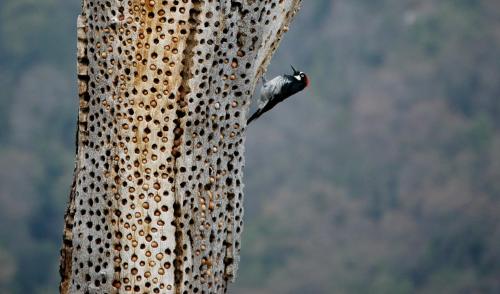
As autumn arrives each year, acorn woodpeckers in the foothills...


As autumn arrives each year, acorn woodpeckers in the foothills begin harvesting acorns. The birds create holes in trees to store their bounty. Trees used by woodpeckers for storage are called granary trees, and may have up to 50,000 holes, each filled with an acorn.
Illusions in the Cosmic Clouds
![]() |
Pareidolia is the psychological phenomenon where people see recognizable shapes in clouds, rock formations, or otherwise unrelated objects or data. There are many examples of this phenomenon on Earth and in space. When an image from NASA's Chandra X-ray Observatory of PSR B1509-58 -- a spinning neutron star surrounded by a cloud of energetic particles --was released in 2009, it quickly gained attention because many saw a hand-like structure in the X-ray emission. In a new image of the system, X-rays from Chandra in gold are seen along with infrared data from NASA's Wide-field Infrared Survey Explorer (WISE) telescope in red, green and blue. Pareidolia may strike again as some people report seeing a shape of a face in WISE's infrared data. What do you see? NASA's Nuclear Spectroscopic Telescope Array, or NuSTAR, also took a picture of the neutron star nebula in 2014, using higher-energy X-rays than Chandra. PSR B1509-58 is about 17,000 light-years from Earth. JPL, a division of the California Institute of Technology in Pasadena, manages the WISE mission for NASA. NASA's Marshall Space Flight Center in Huntsville, Alabama, manages the Chandra program for. The Smithsonian Astrophysical Observatory in Cambridge, Massachusetts, controls Chandra's science and flight operations. Image Credit: X-ray: NASA/CXC/SAO; Infrared: NASA/JPL-Caltech |
NASA's Terra Satellite Shows a More Organized Tropical Storm Ana
The strong southwesterly wind shear that has been battering Tropical Storm Ana has abated and has given the storm a chance to re-organize. Ana appeared more rounded on imagery from NASA's Terra satellite as thunderstorms again circled the low-level center.
NASA's Terra satellite passed over Ana on Oct. 22 at 22:10 UTC (6:10 p.m. EDT). The MODIS instrument aboard Terra captured a visible image of the storm that showed clouds and showers were no longer being blown northeast of the center from southwesterly wind shear, as they had in the last couple of days. The wind shear has weakened, which allowing for the showers and thunderstorms to redevelop around the center of the storm.
On Oct. 24, Ana was strengthening and moving northwest while crossing the northwest Hawaiian Islands east of Maro Reef.
A Tropical Storm Warning is in effect for portions of the Papahanaumokuakea Marine National Monument, from French Frigate Shoals to Lisianski.
At 8 a.m. (2 a.m. HST/1200 UTC) the center of Tropical Storm Ana was located near latitude 26.0 north and longitude 168.6 west. Ana was moving toward the northwest near 12 mph (19 kph) and this motion is expected to become more northerly through early Friday, then northeasterly through early Saturday, Oct. 25. Maximum sustained winds were near 50 mph (80 kph).
NOAA's Central Pacific Hurricane Center expects Ana to continue strengthening through early Saturday.
FINAL CANDIDATE BRIEFING 2015 PRIMARY NOMINATING ELECTION
LOS ANGELES (October 23, 2014) - Los Angeles City Clerk Holly L. Wolcott invites candidates planning to file in the 2015 Primary Nominating Election to join the Office of the City Clerk - Election Division for a briefing on candidate filing and deadline requirements for this upcoming Election. The Election Division will explain in detail the procedures related to filing the Declaration of Intention to Become a Candidate and the nominating petition, which allow a candidate to qualify for the ballot.
All candidates for City Council and the Los Angeles Unified School District (LAUSD) must have resided in the applicable jurisdiction or district in which they are running for office since October 4, 2014. Los Angeles Community College District (LACCD) Board of Trustees candidates are required to be residents of the LACCD at the time of filing for candidacy.
City Clerk Wolcott strongly recommends that all potential candidates who did not attend the previous briefing that was offered on Saturday October 18, 2014, attend this final briefing which will be similarly held at the Election Division office in Piper Technical Center:
Date: Saturday, November 1, 2014
Time: 10:00 a.m.
Location: Piper Technical Center
Office of the City Clerk - Election Division
555 Ramirez St., Space 300
To make reservations or ask questions about the event, please call the City Clerk - Election Division at (213) 978-0444 between 8:00 a.m. and 5:00 p.m., Monday through Friday. When you call to RSVP, please indicate your contact information and the number in your party.
The Election Division briefings described above are not substitutes for the separate Ethics Commission candidate and treasurer training sessions, which are mandatory for City of Los Angeles and Los Angeles Unified School District seats. Please visit the Ethics Commission’s website for more information about their training sessions athttp://ethics.lacity.org.
The Office of the City Clerk - Election Division administers elections for the City of Los Angeles, the Los Angeles Unified School District, and the Los Angeles Community College District. The City’s Primary Nominating Election will be held March 3, 2015 and the General Municipal Election will be held May 19, 2015. More information can be found on the Election Division’s website at:http://clerk.lacity.org/elections/.
Obama, Hagel Offer Canada Assistance after Attacks
By Cheryl Pellerin
DoD News, Defense Media Activity
WASHINGTON, Oct. 23, 2014 - President Barack Obama and Defense Secretary Chuck Hagel have offered condolences, assistance and continuing close partnership to Canadian Prime Minister Stephen Harper, the people of Canada and the family and friends of two soldiers killed in attacks there this week.
|
In remarks yesterday, Harper praised Warrant Officer Patrice Vincent, who was killed in a hit-and-run attack "by an ISIL-inspired terrorist," and Cpl. Nathan Cirillo of the Argyll and Sutherland Highlanders, who was "murdered in cold blood" as he provided a ceremonial Honor Guard at Canada's National War Memorial.
Both assailants were killed.
Yesterday, Obama and Hagel both made statements about the attacks.
"I had a chance to talk with Prime Minister Harper this afternoon," Obama said during a White House press conference on the U.S. response to the West Africa Ebola crisis. "Obviously, the situation there is tragic ... and I expressed on behalf of the American people our condolences to the family and to the Canadian people as a whole."
Statement by Chuck Hagel
In his statement, Hagel said he joined all the men and women of the U.S. Department of Defense in offering his deepest condolences to the family and friends of the soldiers killed in this week's appalling attacks on members of the Canadian Armed Forces.
"The United States strongly condemns today's shootings in Ottawa," the secretary added, "as well as the hit-and-run attack in Quebec earlier this week. The United States has no closer friend and ally than Canada, and the United States military has no closer partner than the Canadian Armed Forces."
Hagel said the Defense Department, "including through the North American Aerospace Defense Command, will continue to monitor the situation closely and stands ready to assist our Canadian allies in the aftermath of these tragic events."
The North American Aerospace Defense Command, based in Colorado and also known as NORAD, is a combined organization of the United States and Canada that provides aerospace warning, air sovereignty and defense for Northern America.
Vigilance is essential
From the Oval Office, Obama said the attacks emphasize the degree to which nations must remain vigilant when it comes to dealing with acts of senseless violence or terrorism.
"I pledged, as always, to make sure that our national security teams are coordinating very closely, given not only that Canada is one of our closest allies in the world but they're our neighbors and our friends," Obama said.
When it comes to dealing with terrorist activity, the president added, Canada and the United States have to be entirely in sync.
Obama said he's traveled to the Canadian Parliament in Ottawa and recalled how warmly he was received; adding that during his call with Harper, the prime minister appreciated expressions of concern by the American people.
The attacks in Canada will have to be factored into ongoing efforts in the United States to counter terrorist attacks in this country, the president said.
"Every single day we have a whole lot of really smart, really dedicated, really hardworking people ... who are monitoring risks and making sure that we're doing everything we need to do to protect the American people," he said. "And they don't get a lot of fanfare; they don't get a lot of attention."
Many possible threats are foiled or disrupted that don't always get reported on, the president said.
"The work of our military, our intelligence teams, the Central Intelligence Agency, the intelligence community more broadly, our local law enforcement and state law enforcement officials who coordinate closely with us," Obama said, "we owe them all a great deal of thanks."
USGS News Release: Science and Policy Working Together to Help the Delta
Learn How the Disciplines Collaborate at the Bay-Delta Science Conference
SACRAMENTO, Calif. — Successfully resolving California’s long-standing water supply and ecosystem restoration conflicts in the Delta depends on sound policy based on the best available science.Fostering that collaboration is the backdrop for the 8th Biennial Bay-Delta Science Conference, October 28-30, 2014, jointly sponsored by the Delta Stewardship Council and the U.S. Geological Survey. More than 1,000 scientists, managers, and policymakers will gather in Sacramento to discuss the latest advances in scientific information and ideas on water resource management in the Delta, its watershed, and the San Francisco Estuary.
“Policies addressing California’s current drought, ensuring long-term water supplies, and protecting the health of the Bay-Delta environment must be based on the best available science,” said Mike Connor, Deputy Secretary of the Interior and the department’s lead water policymaker. “The Department of the Interior commends the Delta Stewardship Council and USGS for setting up this conference to bring decision makers together with scientists.”
“This is a major conference that highlights the most recent discoveries that influence management decisions on the Delta,” said Dr. Peter Goodwin, lead scientist for the Delta Science Program. “These discoveries include: how to anticipate and prepare for severe storms; assessing the risk of mercury impacts and new ways to minimize those impacts; and the importance of floodplains as fish food producers.”
The Delta, formed by the Sacramento and San Joaquin Rivers, is the largest estuary on the West Coast of the Americas, the hub of both the state and federal water projects, and a region of agriculture and recreational importance. These often conflicting uses have bedeviled policy makers and scientists for decades.
This year’s theme is “Making Connections,” in the spirit of “One Delta, One Science,” and highlights how management of the Bay-Delta ecosystem is at a critical juncture. Political and regulatory mandates require new ways of managing water exports while also restoring landscape-level ecosystem attributes and functions. To support these activities, scientists must make connections among the external forces that impact the system, management actions, and ecosystem responses. Equally critical is a two-way flow of communication between scientists and managers to better understand their respective needs, available resources, and ideas.
The conference will be held at the Sacramento Convention Center, 1400 J Street, and begins with a plenary session at 9:00 a.m. on October 28. Participants include: Mike Connor, Deputy Secretary of the Interior as an invited speaker; Council Chair Randy Fiorini talking about the need for science that can influence strategies, planning, and behaviors that affect the environment; Dr. Goodwin highlighting six things the Delta science community has learned in the last two years; Delta Independent Science Board member Dr. Stephen Brandt talking about habitat quality from a fish’s perspective; and former Interagency Ecological ProgramLead Scientist and current Associate Director for Projects at the U.S. Geological Survey, Dr. Anke Mueller-Solger, discussing new approaches to resolving scientific uncertainties in the estuary.
Several special sessions include: a discussion on the management of water and the ecosystem’s health through a drought; whether or not climate science can influence public policy in an era of drought; and “Funding the Delta’s Fiscal Orphans: Science, Governance, and Ecosystem Stress Relief” with an opening presentation by Ellen Hanak of the Public Policy Institute of California.
The Delta Science Program partners with the Delta Conservancy in a discussion on Policy, Floodplains, and Toxics. This includes a session on implementing theDelta Science Plan followed by a presentation on the Interim Science Action Agenda. There will also be highlights of June’s Data Summit where a new era in information management and knowledge discovery was discussed.
The conference also features sessions on water policy including: predicting outcomes and working towards reconciliation; and the direct and indirect effects of large-scale restoration and its implications for science and management. A presentation on the Delta Independent Science Board’s comments regarding the Bay Delta Conservation Plan and its reliance on habitat restoration is also scheduled. Approximately 185 posters will also be available for viewing during receptions on Tuesday andWednesday from 5:15 p.m. to 7:15 p.m. on the 1st floor of the Convention Center.
This year’s conference is co-chaired by Dr. Lenny Grimaldo, a fish biologist and water resource manager at ICF International, and Dr. Wim Kimmerer, a marine biology research professor at San Francisco State University. More information is available at Science Conference 2014.
"Coequal goals" means the two goals of providing a more reliable water supply for California and protecting, restoring, and enhancing the Delta ecosystem. The coequal goals shall be achieved in a manner that protects and enhances the unique cultural, recreational, natural resource, and agricultural values of the Delta as an evolving place.” – CA Water Code §85054