Monday, September 15, 2014

Satellites Show Edouard's Transition into an Atlantic Hurricane

This GOES-East satellite image animation of Edouard from Sept. 13 through 15 showed the storm consolidating. The eye of the hurricane became visible on and off during Sept. 14 in between being obscured by high clouds, and the eye opened again on Sept. 15. TRT: 0:35
Image Credit: 
NASA/NOAA GOES Project
Satellites Show Edouard's Transition into an Atlantic Hurricane

NASA's Terra satellite passed over Tropical Storm Edouard each day from September 12 through 14 and captured imagery of the storm as it grew into a hurricane.  NOAA's GOES-East satellite covers the Atlantic Ocean and takes visible images during the day and infrared images at night to show the movement of weather systems. Those images were compiled into a movie from Sept. 13 through 15 showing movement and intensification of Edouard into a hurricane. NASA's HS3 Mission also investigated the storm.

NASA's Terra satellite captured the three images of Edouard as it transitioned into a hurricane. When Terra flew over the storm, the Moderate Resolution Imaging Spectroradiometer (MODIS) instrument captured visible images on September 12 at 9:10 a.m. EDT, September 13 at 9:50 a.m. EDT, and September 14 at 10:35 a.m. EDT. The three images together show that Edouard consolidated as it strengthened - that is, bands of thunderstorms became more tightly wrapped around the storm. By September 14, the bands of thunderstorms were concentrated over the northern quadrant of the storm and wrapping into the cloud-filled eye.

MODIS images of Edouard
NASA's Terra satellite captured these three images of Edouard as it transitioned into a hurricane, from Sept. 12 (left) to Sept. 13 (center) and finally as a hurricane on Sept. 14 (right) in the Atlantic Ocean.
Image Credit: 
NASA Goddard MODIS Rapid Response Team
The NASA/NOAA GOES Project at NASA's Goddard Space Flight Center in Greenbelt, Maryland combined NOAA's GOES-East satellite imagery of Edouard taken over several days from September 13 through 15. The showed the storm consolidating. The eye of the hurricane became visible on and off during September 14 in between being obscured by high clouds, and the eye opened again on September 15.   

On Sunday morning, September 14, 2014 at 1102 UTC (7:02 a.m. EDT) NASA's Global Hawk 872 took off from NASA's Wallops Flight Facility, Virginia on a flight toward Tropical Storm Edouard for a 24 hour mission. It was the sixth science flight for the Global Hawk during the Hurricane and Severe Storms Sentinel or HS3 mission. For more information about NASA's HS3 mission, visit: www.nasa.gov/hs3

On Sunday at 5 p.m. EDT Edouard's maximum sustained winds had increased to near 85 mph (140 mph) and additional strengthening is forecast. The National Hurricane Center (NHC) noted on Monday, September 15 at 11 a.m. EDT that Edouard's maximum sustained winds increased to 105 mph (165 kph) making it a Category 2 hurricane on the Saffir-Simpson Scale.

NHC forecaster Cangliaosi noted "Satellite images show that the eye of Edouard has become larger and more distinct during the past few hours, with a fairly symmetric inner-core convective pattern."

The center of Hurricane Edouard was near latitude 27.3 north and longitude 55.5 west. That's about 655 miles (1,055 km) east-southeast of Bermuda. Edouard was moving toward the northwest near 14 mph (22 kph) and a movement toward the north is expected on Tuesday, September 16. The estimated minimum central pressure is 966 millibars.

The NHC forecast calls for some strengthening through the end of the day on September 16 while the hurricane remains in favorable conditions.  Beyond that time, cooler water, dry air, and a pronounced increase in wind shear is expected to cause Edouard to weaken steadily.

Rob Gutro
NASA's Goddard Space Flight Center


Suomi NPP image of Edouard
When NASA-NOAA's Suomi NPP passed over Edouard on Sept. 12 at 12:37 a.m. EDT it took this infrared image that showed very high thunderstorms with very cold cloud top temperatures surrounding the center.
Image Credit: 
NRL/NASA/NOAA
Sept. 12, 2014 - NASA-NOAA Suomi NPP Sees Formation of Tropical Storm Edouard

The sixth tropical depression of the Atlantic Ocean hurricane season formed in the central Atlantic Ocean yesterday, and today, September 12, it strengthened into Tropical Storm Edouard. NASA-NOAA's Suomi NPP satellite flew over Edouard and provided forecasters with an infrared view of what's happening within the strengthening storm.

When Suomi NPP passed over Edouard on September 12 at 04:37 UTC (12:37 a.m. EDT), the Visible Infrared Imaging Radiometer Suite or VIIRS instrument aboard captured an infrared image of the storm. The infrared data shows temperature, an indicated that there were very high thunderstorms with very cold cloud top temperatures surrounding the center of the low level circulation.

VIIRS is a scanning radiometer that collects visible and infrared imagery and "radiometric" measurements. Basically it means that VIIRS data is used to measure cloud and aerosol properties, ocean color, sea and land surface temperature, ice motion and temperature, fires, and Earth's albedo (reflected light).

At 11 a.m. EDT (1500 UTC) the center of Tropical Storm Edouard was located near latitude 18.5 north and longitude 43.0 west. That's about 1,315 miles (2,120 km) east of the Northern Leeward Islands  Edouard is moving toward the west-northwest near 16 mph (26 kph) and this motion with a gradual decrease in forward speed is expected during the next couple of days.

Maximum sustained winds have increased to near 45 mph (75 kph) and some slight strengthening is possible during the next two days.

Forecaster Avila of the National Hurricane Center noted that Edouard is moving toward the west-northwest at 14 knots (16 mph/26 kph) steered by the flow around the edge of a large elongated area of high pressure known as the Atlantic subtropical ridge. A gradual turn to the northwest and north is forecast in about 3 to 4 days when the ridge weakens.

The National Hurricane Center expects Edouard to become a hurricane by Monday, September 15 and stay east of Bermuda, curving back to the northeast.

Rob Gutro
NASA's Goddard Space Flight Center


Tropical Depression 6
This visible image of Tropical Depression 6 was taken by NOAA's GOES-East satellite at 7:45 a.m. EDT on September 11 as it developed. Credit:
Image Credit: 
NASA/NOAA GOES Project
Sept. 11, 2014 - Satellite View of Newborn Atlantic Tropical Depression 6

The sixth tropical depression of the Atlantic Ocean Hurricane Season formed in the Eastern Atlantic Ocean and NOAA's GOES-East satellite captured it.

A visible image of Tropical Depression 6 was taken by NOAA's GOES-East satellite at 7:45 a.m. EDT on September 11 as it developed. The image was created by NASA/NOAA's GOES Project at the NASA Goddard Space Flight Center in Greenbelt, Maryland.

In addition to using GOES imagery and data from other NOAA and NASA satellites, The National Hurricane Center also uses measurements from the Advanced Scatterometer or ASCAT instrument that flies aboard the EUMETSAT METOP satellite. Forecaster Beven at the National Hurricane Center noted "Satellite imagery and a recent ASCAT-B overpass indicate that the low pressure area over the eastern Atlantic has a well-defined circulation and organized convective banding near the center."

At 11 a.m. EDT Tropical Depression Six had maximum sustained winds near 35 mph (55 kph) and the depression could become a tropical storm later in the day. The center of Tropical Depression Six was located near latitude 16.2 north and longitude 37.1 west, about 870 miles (1,400 km) west of the Cape Verde Islands. The depression is moving toward the northwest near 13 mph (20 kph) and is expected to move northwest or west-northwest is expected during the next couple of days. The estimated minimum central pressure is 1007 millibars.

Despite being in an area of wind shear, the NHC noted that computer model guidance forecasts slow but steady strengthening.


Satellite Sees Tropical Depression 16-E Remnants Scooped by Hurricane Odile


At 11 p.m. EDT on Sunday, September 14, Tropical Depression 16-E was officially a remnant low pressure area. NOAA's GOES-West satellite showed the clouds associated with the remnants being drawn into the massive circulation of nearby Hurricane Odile.  

At 5 a.m. on Sunday, September 14, Tropical Depression 16-E (TD 16-E) was still holding together despite being close to the circulation of Hurricane Odile. At that time, the center of tropical depression 16-E was located near latitude 14.9 north and longitude 115.3 west. That's about 655 miles (1,055 km) south-southwest of the southern tip of Baja California.  The depression was moving toward the east near 12 mph (19 kph). Maximum sustained winds were near 35 mph (55 kph).

By 11 p.m. that night, the remnant low pressure area was located near 16.3 north latitude and 112.3 west longitude, about 480 miles (775 km) south-southwest of the southern tip of Baja California, Mexico. Its maximum sustained winds were still near 35 mph (55 kph), but were waning. It was moving to the east-northeast at 13 mph (20 kph).

The National Hurricane Center noted that "satellite imagery suggests that the tropical depression no longer has a well-defined closed surface circulation."

By 9:45 a.m. EDT on September 15, the remnants of TD16-E were being absorbed into Hurricane Odile, which was located near the western coast of Mexico. NOAA's GOES-West satellite saw the clouds associated with the remnants wrapping into southwestern side of Odile. The image was created by the NASA/NOAA GOES Project at NASA's Goddard Space Flight Center in Greenbelt, Maryland.  In the image, the remnants appeared as a small shapeless area of clouds being drawn into the larger counter-clockwise circulation of the hurricane.    

Rob Gutro
NASA's Goddard Space Flight Center


GOES Image of 16E and Odile
This NOAA GOES-West image taken Sept. 12 at 8 a.m. EDT shows Tropical Depression 16E (left) is about 10 times smaller in comparison to Tropical Storm Odile (right).
Image Credit: 
NASA/NOAA GOES Project
Sept. 12, 2014 - Tropical Storm Odile Expected to "Eat" Tropical Depression 16E

An infrared picture of Tropical Depression 16E from NOAA's GOES-West satellite shows the tiny storm dwarfed by nearby Tropical Storm Odile. Odile is expected to draw the depression into its circulation and "eat" it in the next few days.

The image of the Eastern Pacific Ocean and the two storms was taken at 8 a.m. EDT (5 a.m. PDT) on September 12. It shows that Tropical Depression 16E (TD16E) is about 10 times smaller in comparison to Tropical Storm Odile, located to its east. NOAA manages the GOES-West satellite but the image was created by the NASA/NOAA GOES Project at NASA's Goddard Space Flight Center in Greenbelt, Maryland.

The National Hurricane Center noted that TD16E is unable to intensify because of its close proximity to Tropical Storm Odile.

Forecaster Pasch at NOAA's National Hurricane Center noted that center of TD16E is very difficult to find on geostationary images (like GOES-West). Pasch noted that an image from the Special Sensor Microwave Imager aboard a Defense Meteorological Satellite Program satellite taken at 1056 UTC (6:56 a.m. EDT) indicated that TD16E's center continued to be located near the northeastern edge of the main area of thunderstorms. However, first-light visible pictures suggested that the low-level circulation is poorly defined.

At 11 a.m. EDT (8 a.m. PDT) TD16E's maximum sustained winds were near 35 mph (55 kph) and little change in strength is expected over the next two days. The center of the depression was located near latitude 16.6 north and longitude 120.0 west. That's about 785 miles (1,265 km) west-southwest of the southern tip of Baja California, Mexico.  The depression is drifting toward the north near 2 mph (4 kph) and is expected to turn east then east-southeast as it gets caught up in Odile's circulation.

Pasch noted that the unfavorable influence of the much larger circulation of Tropical Storm Odile, centered about 800 nautical miles east, will hamper the depression's ability to strengthen. In fact, the depression is expected to dissipate in the next day or two, while being absorbed by Odile.

Rob Gutro
NASA's Goddard Space Flight Center


AIRS image of TD16E
This infrared image of newborn Tropical Depression 16E was taken by the AIRS instrument aboard NASA's Aqua satellite and shows cold, strong thunderstorms around the center (purple).
Image Credit: 
NASA JPL/Ed Olsen
Sept. 11, 2014 - NASA's Aqua Satellite's Baby Announcement for Tropical Depression 16E

In an infrared "new baby announcement" NASA's Aqua satellite provided a picture of the newborn tropical depression 16E in the Eastern Pacific Ocean.

The Atmospheric Infrared Sounder or AIRS instrument aboard NASA's Aqua satellite captured infrared data just before Tropical Depression 16E was named by the National Hurricane Center on September 11. The AIRS data showed cold cloud tops of strong thunderstorms circled around the center of the storm's circulation. Those storms had cloud top temperatures near -63F/-53C indicating they were high into the troposphere and had the potential to generate heavy rain.

At 8:30 a.m. PDT (11:30 a.m. EDT) the center of tropical depression Sixteen-E was located near latitude 16.1 north and longitude 119.4 west. That's about 775 miles (1,250 km) southwest of the southern tip of Baja California, Mexico.

Maximum sustained winds are near 35 mph (55 kph) and the National Hurricane Center noted that slight strengthening is possible during the next 24 hours and the depression is expected to become a tropical storm. Weakening is forecast after that time. The depression is moving toward the north-northwest near 12 mph (19 kph) and is expected to turn toward the north and northeast followed by a turn to the east or east-southeast.

Cracking the Code to Innovation 7 Steps That Guarantee Success


Everyone says they want innovation in their organization, but when an ambitious employee offers it to a CEO, for example, the idea is often shot down, says Dr. Neal Thornberry, faculty director for innovation initiatives at the Naval Postgraduate School in California.

“Senior leaders often miss the value-creating potential of a new concept because they either don’t take the time to really listen and delve into it, or the innovating employee presents it in the wrong way,” says Thornberry, who recently published “Innovation Judo,” (www.NealThornberry.com ), based on his years of experience teaching innovation at Babson College and advising an array of corporate clients, from the Ford Co. and IBM to Cisco Systems. 

“Innovation should be presented as opportunities, not ideas. Opportunities have gravitas while ideas do not!”

Thornberry outlines a template for innovation that work:

•  Intention: Once the “why” is answered, leaders have the beginnings of a legitimate roadmap to innovation’s fruition. This is no small task and requires some soul searching.

“I once worked with an executive committee, and I got six different ideas for what ‘innovation’ meant,” he says. “One wanted new products, another focused on creative cost-cutting, and the president wanted a more innovative culture. The group needed to agree on their intent before anything else.”

•  Infrastructure: This is where you designate who is responsible for what. It’s tough, because the average employee will not risk new responsibility and potential risk without incentive. Some companies create units specifically focused on innovation, while others try to change the company culture in order to foster innovation throughout.  “Creating a culture takes too long,” Thornberry says. “Don’t wait for that.”

•  Investigation: What do you know about the problem? IDEO may be the world’s premier organization for investigating innovative solutions. Suffice to say that the organization doesn’t skimp on collecting and analyzing data. At this point, data collection is crucial, whereas brainstorming often proves to be a waste of time if the participants come in with the same ideas, knowledge and opinions that they had last week with no new learning in their pockets.

•  Ideation: The fourth step is also the most fun and, unfortunately, is the part many companies leap to. This is dangerous because you may uncover many exciting and good ideas, but if the right context and focus aren’t provided up front, and team members cannot get on the same page, then a company is wasting its time. That is whyintentmust be the first step for any company seeking to increase innovation. Innovation should be viewed as a set of tools or processes, and not a destination.

•  Identification: Here’s where the rubber meets the road on innovation. Whereas the previous step was creative, now logic and subtraction must be applied to focus on a result. Again, ideas are great, but they must be grounded in reality. An entrepreneurial attitude is required here, one that enables the winnowing of ideas, leaving only those with real value-creating potential.

“Innovation without the entrepreneurial mindset is fun but folly,” Thornberry notes.

•  Infection: Does anyone care about what you’ve come up with? Will excitement spread during this infection phase? Now is the time to find out. Pilot testing, experimentation and speaking directly with potential customers begin to give you an idea of how innovative and valuable an idea is. This phase is part selling, part research and part science. If people can’t feel, touch or experience your new idea in part or whole, they probably won’t get it. This is where the innovator has a chance to reshape their idea into an opportunity, mitigate risk, assess resistance and build allies for their endeavor.

•  Implementation/Integration:While many talk about this final phase, they often fail to address the integration part. Implementation refers to tactics that are employed in order to put an idea into practice. This is actually a perilous phase because, in order for implementation to be successful, the idea must first be successfully integrated with other activities in the business and aligned with strategy. An innovation, despite its support from the top, can still fail if a department cannot work with it.

About Neal Thornberry, Ph.D.

Neal Thornberry, Ph.D., is the founder and CEO of IMSTRAT, LLC a consulting firm that specializes in helping private and public sector organizations develop innovation strategies that create economic value by increasing an organization’s effectiveness and efficiency. A respected thought leader in innovation, Thornberry is a highly sought-after international speaker and consultant. He  also serves as the faculty director for innovation initiatives at the Center for Executive Education at the Naval Postgraduate School in Monterey, Calif. Thornberry, author of “InnovationJudo:Disarming Roadblocks & Blockheads on the Path to Creativity” (www.NealThornberry.com), holds a doctorate in organizational psychology and specializes in innovation, corporate entrepreneurship, leadership and organizational transformation.

Crescent Mimas


09/15/2014 12:00 PM EDT
A thin sliver of Mimas is illuminated, the long shadows showing off its many craters, indicators of the moon's violent history. The most famous evidence of a collision on Mimas (246 miles, or 396 kilometers across) is the crater Herschel that gives Mimas its Death Star-like appearance. See PIA12568 for more on Herschel. This view looks toward the anti-Saturn hemisphere of Mimas. North on Mimas is up and rotated 40 degrees to the right. The image was taken in visible light with the Cassini spacecraft narrow-angle camera on May 20, 2013. The view was acquired at a distance of approximately 100,000 miles (200,000 kilometers) from Mimas and at a Sun-Mimas-spacecraft, or phase, angle of 130 degrees. Image scale is 4,000 feet (1 kilometer) per pixel. The Cassini-Huygens mission is a cooperative project of NASA, the European Space Agency and the Italian Space Agency. The Jet Propulsion Laboratory, a division of the California Institute of Technology in Pasadena, manages the mission for NASA's Science Mission Directorate, Washington, D.C. The Cassini orbiter and its two onboard cameras were designed, developed and assembled at JPL. The imaging operations center is based at the Space Science Institute in Boulder, Colo. For more information about the Cassini-Huygens mission visit http://www.nasa.gov/cassini andhttp://saturn.jpl.nasa.gov . The Cassini imaging team homepage is athttp://ciclops.org . Credit: NASA/JPL-Caltech/Space Science Institute

ScottMadden to Partner with SEPA for Fact-Finding Mission – Exploring the Energy Transition in Germany

ScottMadden, Inc., one of North America’s leading energy consulting firms, is proud to join the Solar Electric Power Association (SEPA) to lead a group of approximately 25 U.S. energy industry executives to the bellwether energy market of Germany to exchange information with electricity and solar market leaders who are adapting to change in this dynamic and controversial environment.


This select group of executives will meet with energy industry peers with the goal of returning with insights and practical knowledge that can be applied to planning and business decisions in the United States. The trip, taking place September 14–18, will feature face-to-face meetings with thought leaders and decision makers from the electric utility, transmission, and renewable energy industries; government, trade, and industry associations; and market experts. The program will be interactive and focus on questions including:


  • What are the objectives of the energy transition? Have the selected policies been effective in meeting those objectives?
  • What unanticipated impacts have emerged? How are they being addressed?
  • What new business models can help electric utilities adapt and grow in a market with significant distributed generation penetration and declining revenue?
  • What tools are needed to cost effectively shift from a traditional fuel mix to a greater renewable resource mix without sacrificing reliability?
  • Who has developed a successful road map for energy company transition?


Chris Vlahoplus, partner and clean tech & sustainability practice leader at ScottMadden, and John Pang, partner at ScottMadden, will attend this event. For real time updates, follow them@ChrisVlahoplus and @PangJohnC.


For more information about this event, please contact us.


About ScottMadden’s Clean Tech & Sustainability Practice

Leveraging our energy expertise, the ScottMadden Clean Tech & Sustainability practice helps our clients effectively navigate through the quickly changing energy landscape. We specialize in assisting our clients with sustainable energy strategies and making smart portfolio choices. We work with our clients to understand and effectively utilize cleaner, renewable sources of energy, such as nuclear, wind, solar, biomass, and biofuels. Our experienced team of energy practitioners understands the roles of energy efficiency, demand response, and storage as part of an integrated strategy. We also assist clients with sustainability, bringing an understanding of energy-unique concerns. 


About ScottMadden, Inc.

ScottMadden is the management consulting firm that does what it takes to get it done right. Our practice areas include Energy, Clean Tech & Sustainability, and Corporate & Shared Services. We deliver a broad array of consulting services ranging from strategic planning through implementation across many industries, business units, and functions. To learn more, visitwww.scottmadden.com | Twitter |Facebook | LinkedIn


About Solar Electric Power Association

The Solar Electric Power Association (SEPA) is an educational non-profit dedicated to helping utilities integrate solar power into their energy portfolios for the benefit of the utility, its customers, and the public good. With 900 utility and solar industry members, SEPA provides unbiased utility solar market intelligence, up-to-date information about technologies and business models, and peer-to-peer interaction. From hosting national events to providing utility strategies, SEPA helps utilities make smart solar decisions. For more information, visitwww.solarelectricpower.org


Troops From 15 Nations Begin Exercise in Ukraine


DoD News, Defense Media Activity

WASHINGTON, Sept. 15, 2014 - Troops from 15 nations kicked off the annual Rapid Trident field training exercise today in northwestern Ukraine.

Navy Capt. Greg Hicks, director of communication and engagement for U.S. European Command, emphasized in a statement that the exercise is annual, and that it was planned well before the current situation in Ukraine.

About 1,300 military personnel from Ukraine, Azerbaijan, Bulgaria, Canada, Georgia, Germany, Great Britain, Latvia, Lithuania, Moldova, Norway, Poland, Romania, Spain and the United States, as well as representatives from NATO, will participate.

The exercise will take place near Yavoriv at the International Peacekeeping and Security Center, which is designed to support multinational training and exercises with regional and bilateral partners, Hicks said.

In preparation, units underwent a week of situational training that focused on key exercise tasks such as countering improvised explosive devices, convoy operations and patrolling.

No live-fire exercises are scheduled for Rapid Trident, Hicks said. The exercise will conclude Sept. 26.


MANHATTAN BEACH CITY COUNCIL UNANIMOUSLY ENDORSES BEN ALLEN FOR STATE SENATE


Ben Allen Scores Suite of Manhattan Beach Endorsements

Santa Monica, CA -- A number of prominent local Manhattan Beach elected officials, including the entire current Manhattan Beach City Council, have endorsed Santa Monica-Malibu Unified School District Board Member Ben Allen in his campaign for the 26th State Senate District. 
 

The endorsing leaders include former Mayors Portia Cohen and Steve Napolitano, current Mayor Amy Howorth, current Mayor Pro Tempore Wayne Powell, and current Councilmembers Mark Burton,Tony D’Errico, and David J. Lesser. All of these prominent Manhattan Beach government leaders heartily endorse Ben as the best State Senate candidate.

Portia Cohen, former Mayor of Manhattan Beach, announces her endorsement, “Ben Allen is smart, hardworking, and knowledgeable about local government issues. I know that he will be a committed leader and is the perfect fit for State Senate.”
 

Similarly, Amy Howorth, current Mayor of Manhattan Beach and former State Senate candidate, says, “Ben's also shown himself to be someone who possesses the courage of conviction and yet respect for those who he disagrees with.  Because he has the type of character that’s necessary to hold this office, along with his deep lifelong roots in the district and local leadership experience, I trust Ben Allen to represent our district and I am proud to endorse him for the State Senate”.

City Councilmember Mark Burton agrees, “Ben Allen has demonstrated a critical understanding of local issues as well as the unique issues concerning the South Bay. I believe that his knowledge, his record of fiscal responsibility on the school board, and his experience in local government make him the best choice to represent us in the State Senate”.

In their endorsements, all of these community leaders emphasized Ben’s outstanding technical expertise in state and local policy issues, and his long history of community involvement in his home region. With these endorsements, Ben Allen has the unanimous support of the Manhattan Beach City Council.

With their endorsements, these prominent local elected officials join a long list of well-respected local elected officials who are backing Allen for State Senate, including State Senator Fran Pavley and Jerry Hill; Los Angeles County Supervisors Zev Yaroslavsky and Don Knabe. The list also includes numerous local mayors in the District: Beverly Hills Mayor Lili Bosse, Santa Monica Mayor Pam O'Connor, Hermosa Beach Mayor Michael DiVirgilio, Redondo Beach Mayor Steve Aspel,  Palos Verdes Estates Mayor Ellen Perkins, Rancho Palos Verdes Mayor Jerry Duhovic, Rolling Hills Estates Mayor Judith Mitchell, and Avalon Mayor Ann Marshall.

Ben Allen placed first among a crowded field in the open primary for the 26th State Senate District, held on June 3, 2014.
 

The 26th State Senate District consists of the cities of Manhattan Beach, Hermosa Beach, Redondo Beach, Palos Verdes Estates, Rancho Palos Verdes, Rolling Hills, Rolling Hills Estates, El Segundo, Avalon, Lomita, Torrance, Santa Monica, West Hollywood, and Beverly Hills; the Los Angeles neighborhoods of Marina Del Rey, Playa Del Rey, Westchester, Pacific Palisades, Brentwood, Westwood, Westwood Village, Bel Air, Holmby Hills, Little Holmby, Sunset Hills, Beverly Grove, Mar Vista, Mid City West, Miracle Mile, Larchmont Village, Hollywood, Hollywood Hills, Fairfax, Carthay, Fremont Place, Hancock Park, and Windsor Square; and the unincorporated Los Angeles County communities of Marina Del Rey, San Clemente Island, Santa Catalina Island, Franklin, Centinela, and Ocean View.

80-Page Guide Now in Color


September 2014


Dear Editor,


To help take the mystery out of auto service and repair, the non-profit Car Care Council has totally redesigned its popular Car Care Guide, adding 20 additional pages of new information to help motorists be car care aware by better understanding the when, why and how of caring for their vehicles.


Available in English and Spanish, individual copies of the 80-page Car Care Guide can be ordered free of charge by visiting the Car Care Council website atwww.carcare.org/car-care-guide.


New sections include finding an automotive repair shop, alternative fuels, understanding the warranty, vehicle telematics, careers in the auto care industry and an expanded environmental awareness section. The new Car Care Guide was reviewed by industry experts with various backgrounds and areas of expertise and the information has been vetted by car care professionals.


Because properly maintained vehicles perform more safely and dependably for drivers and their families, the Car Care Council offers many other free tools on itswebsite to help consumers drive smart and save money, including a custom service schedule and email reminder service, Car Care Minute videos and Maintenance Mondays tips. The Car Care Council can also be followed on FacebookTwitter,Instagram and Pinterest.


Sincerely,


Rich White

Executive Director

Car Care Council

301-654-6664


Collaboration Drives Achievement in Protein Structure Research


Computational analysis key to structural understanding of molecular machine that targets viral DNA

LOS ALAMOS, N.M., Sept. 15, 2014—When this week’s print issue of the journal Science comes out, a collective cheer will go up from New Mexico, Montana and even the Netherlands, thanks to the type of collaborative effort that is more and more the norm in these connected times. Yes, the research was brilliant, and if we’re lucky, it will produce innovations in biology, medicine, biotechnology and agriculture. It could save lives, and it happened because this scientist talked with that one, that one knew another one, and brilliant minds overcame geographic distance to advance human understanding.

“It is tremendously exciting working with researchers around the world, helping them apply the software and algorithms that we have developed to see the inner workings of molecular machines,” said Thomas Terwilliger, a senior Los Alamos scientist and Laboratory Fellow.

In this case, researchers at Montana State University have provided the first blueprint of a bacterium’s “molecular machinery,” showing how bacterial immune systems fight off the viruses that infect them. By tracking down how bacterial defense systems work, the scientists can potentially fight infectious diseases and genetic disorders. The key is a repetitive piece of DNA in the bacterial genome called a CRISPR, for Clustered Regularly Interspaced Short Palindromic Repeats.

The bacterial genome uses the CRISPR to capture and “remember” the identity of an attacking virus, and now the scientists have created programmable molecular scissors, called nucleases, that are being exploited for precisely altering the DNA sequence of almost any cell type of interest.

The Los Alamos National Laboratory connection is the development of some terrifically clever software, called SOLVE/RESOLVE and PHENIX, in the protein structure analysis of the nuclease. That, connected with the science-community outreach whereby Los Alamos worked directly with structural biologists worldwide on their problems, helped it all come together. Determining the structure of the nuclease is key to understanding its function.

Los Alamos creates advanced algorithms for determining the structures of proteins and other macromolecules, and the software that makes these algorithms easy to use for thousands of structural biologists worldwide. The Laboratory partners with Lawrence Berkeley National Laboratory, Duke and Cambridge universities to create Phenix, a user-friendly and comprehensive software system that guides users through all the complicated steps necessary to determine the 3-D structure of their macromolecule. “One of the best parts of working on the Phenix software is that there is a close-knit team of 15 researchers who work closely together, emailing each other many times every day, to make the software work as smoothly and effectively as possible,” said Terwilliger.

“Some 13,000 scientific papers have used our SOLVE/RESOLVE and Phenix software,” Terwilliger said, and Los Alamos researchers teach crystallographic methods and software tips extensively at scores of workshops around the world. The software licenses, through technology transfer programs, have generated approximately $3M in licensing revenue.

With the new Montana-based research, “therapies that were unimaginable may be possible in the future,” said Blake Wiedenheft, senior author of the paper and assistant professor in MSU’s Department of Microbiology and Immunology. “We know the genetic basis for many plant, animal, and human diseases, and these CRISRP-associated nucleases are now being used in research settings to surgically remove or repair defective genes.”

Funding: Research in the Wiedenheft lab is supported by the National Institutes of Health, the National Science Foundation EPSCoR, the M.J. Murdock Charitable Trust, and the MSU Agricultural Experimental Station. Atomic coordinates for the Cascade structure have been deposited into the public repository (Protein Data Bank) under access code 4TVX.

Journal reference: Ryan N. Jackson, Sarah M. Golden, Paul B. G. Van Erp, Joshua Carter, Edze R. Westra, Stan J. J. Brouns, John Van Der Oost, Thomas C. Terwilliger, Randy J. Read, Blake Wiedenheft.Crystal structure of the CRISPR RNA–guided surveillance complex from Escherichia coli. Science, 2014 DOI: 10.1126/science.1256328

State's Top Law Enforcement Officials Endorse Jeff Prang for Los Angeles County Assessor


Los Angeles County -- California's Attorney General, Kamala Harris, is asking voters to check the box next to Jeff Prang's name for Los Angeles County Assessor in the Nov. 4th General Election. 

"I am proud to endorse Jeffrey Prang for Los Angeles County Assessor," Attorney General Kamala D. Harris said in a prepared statement announcing her endorsement of Mr. Prang . "Mr. Prang has had a distinguished public career as mayor and councilmember, and his professional acumen and competence as a veteran public manager are just what is needed to help restore confidence in this important public agency."

Mr. Prang, special assistant assessor and the leading candidate to become the Assessor, said he was grateful for the support of California's top law enforcement official, Kamala Harris: "In many ways, Ms. Harris inspires me to keep moving forward, despite obstacle or challenges. Ms. Harris is a great leader and I'm humbled and truly honored to have her support." 

Furthermore, Mr. Prang has earned the support of former California Attorney General and Los Angeles District Attorney John Van de Kamp as well as Los Angeles City Attorney Mike Feuer, whose office prosecutes hundreds of criminal cases annually in the city of Los Angeles. 

In fact, City Attorney Feuer had this to say about Jeff Prang: "I have worked with Jeff Prang for nearly 20 years. He has earned a strong reputation for competence and integrity." 

"Jeff will be a positive force for change in the Assessor's Office and will apply his considerable skills toward instituting much-needed reform. I am confident Jeff will restore integrity to the Office and be an effective and innovative leader," Feuer said.

Jeff Prang played a pivotal role in the stabilization and reform of the Assessor's Office in the wake of the scandal that shook the Office when Assessor John Noguez was indicted on corruption charges. In 2012, Mr. Prang orchestrated Noguez' exit from the Office, and facilitated the appointment of a reform administrator by the Board of Supervisors. As a key member of the reform administration, Prang played a crucial role in implementing reforms, including a ban on campaign contributions to Assessor candidates from tax agents who do business with the Office, and from Assessor employees, and implementing fiscal and management audits. 


Face of Defense: Soldier Pursues Passion for Motocross


By Air Force Staff Sgt. Sheila deVera
Joint Base Elmendorf-Richardson

ANCHORAGE, Alaska, Sept. 15, 2014 - Crowds cheering, dirt and rocks flying as tires spin and sharp, high-speed turns can make a huge impact on a 7 year old.

Click photo for screen-resolution image
Army Sgt. Jeremy Hazard rides his dirt bike during the 7th Annual Alaska Supercross Challenge at the Alaska State Fair in Palmer, Alaska, Aug. 23, 2014. U.S. Air Force photo by Staff Sgt. Sheila deVera
 
(Click photo for screen-resolution image);high-resolution image available.

For Army Sgt. Jeremy Hazard, an 84th Engineer Support Company (Airborne) wheeled vehicle mechanic, it ignited a passion that nothing else ever did. Thirteen years after witnessing dirt bike racing for the first time, he finally got his chance.

"I watched my first supercross during the Alaska State Fair in 2012," Hazard said, "so I decided to join the Anchorage Racing Lions."

Seeing the off-road terrain and aerial jumps, Hazard said, he wanted to experience what the bikers were experiencing.

Desire to experience motocross

But a few obstacles prevented Hazard from taking to the track in 2012. His commitment to the military and preparing for an upcoming deployment halted his dream to try out in the motocross race. "I wanted to participate in the summer series when I first heard about it, but was always in training," he said. "I was deployed from February to October of last year."

But in the back of his mind, Hazard said, he was on the lookout for the next opportunity to join the summer series. After six months of waiting, he finally was able to join the club this year. Hazard started in the "big bike novice" class, and out of the 25 participants, he ended up taking first place in the overall category in the summer series.

High intensity competition

"The high intensity and adrenaline are some of the factors why I wanted to join," Hazard said. "It's fun to show your competitive side."

His family is supportive of his extreme hobby and only asks him to be careful, he said. "My wife supports me and all the crazy things I attempt to do, while my family thinks it's pretty neat that I am doing this," he added. Hazard's wife and 2-year-old son watched him compete in the 3rd Annual Amateur and Youth Supercross Challenge during this year's Alaska State Fair.

Preparing for a race

Hazard said that before a race starts, he analyzes the track. "I try to get a mental feel of how I will do at the race," the Jonesboro, Georgia, native said. "At the start of the race, I try to visualize getting in front."

Initially, starting at fourth place allowed some of the faster riders to get in front of Hazard and caused him to flip on the first lap. "The bike has a lot of power, so you have to work your clutch and brakes, and have good throttle control so you don't fall," he said.

With seven of eight laps to go, Hazard tried to recover. Focusing on his strong areas and taking one competitor at a time, he finished in 10th place.

Encourages others to try motocross

Despite his finish, Hazard said he had a good time and that he advises others who are interested in joining the sport to try it out.

"Even if you do not have a bike, just go out and watch people ride their bikes," the eight-year Army veteran said. "Talk to other riders and ask about their experiences."

Although he is relocating to his next duty station early next year, Hazard said, he hopes to come back to participate in the summer series and state fair in the future.

Site ‘J’ marks the spot for Rosetta’s lander


15-09-2014 12:37 PM BST
 
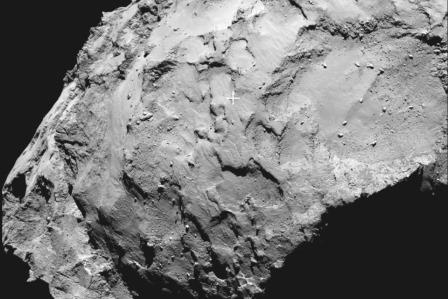
Philae landing site

Rosetta’s lander will target Site J, on Comet 67P that offers unique scientific potential, hints of activity nearby, and minimum risk.